Jan 28, 2026
Enhanced Infrastructure Financing Districts are creative ways to promote redevelopment in California without citywide tax increases or raids on municipal budgets. These special districts are popular in Sacramento.
From Aggie Square on Stockton Boulevard to the Downtown railyards and soccer stadium and a potential Capitol Mall campus for Sac State, the city has embraced special district financing schemes that were once the domain of redevelopment agencies.
Challenges with these plans can get messy. It will be years before their overall efficacy is known. But the idea is straight forward.
Dec 28, 2025
With state employees working remotely, Downtown needs a boost. Our business district always depended on state workers for daytime vitality. Despite recent progress, Downtown continues to suffer.
Like any big idea, it’s hard to say if this one will ever happen. But Sacramento State University’s compelling proposal for a mixed-use campus on Capitol Mall excites some smart, influential people.
“Downtown is flat on its back,” West Sac developer Mark Friedman tells me. “The daytime population is 40% less than what it was pre-COVID.”
California is the only U.S. location where state employees haven’t been sent back to the office, he notes.
Nov 28, 2025
Not long ago, there was a short list of local developers who could pull off big projects. Their names were Lukenbill, Benvenuti, Tsakopoulos, Petrovich and a few others. Successful people with deep community roots, they had big ideas and access to money. They got things done.
Today, major new players have much deeper roots.
Two Native American tribes, Wilton Rancheria and Shingle Springs Band of Miwok Indians, are investing heavily Downtown, bringing excitement and cash.
“These tribes are making a lot of money and they are investing a lot of money in the core. That is a great thing for the city,” developer Sotiris Kolokotronis tells me. “We should be grateful for that.”
Oct 28, 2025
It doesn’t happen often in politics, but sometimes we get the right outcome despite long odds and low expectations. Senate Bill 79, which encourages high-density housing near major transit hubs in Sacramento and other California cities, is a prime example.
In an interview with Inside, state Sen. Scott Wiener (D-San Francisco), sponsor of several impactful housing bills in recent years, admits he was lukewarm about SB 79 earlier this year.
“We have done a lot of different housing work over the years, and it’s been fantastic,” Wiener says. “But the idea of rezoning around transit is a very tough one politically because so many cities have zoned for single-family homes around the highest quality transit. And that’s just not sustainable for housing or for these (transit) systems.”
Sep 28, 2025
The handful of residents at Joshua’s House in North Sacramento, believed to be the first hospice on the West Coast to serve the homeless population, can finally experience the comfort, dignity and respect elusive for people living on the streets.
The new facility on Larchwood Drive began caring for its terminally ill residents this summer. The site is owned and operated by YoloCares, a nonprofit hospice provider.
As Inside columnist Jeff Harris detailed last month, Joshua’s House founder Marlene von Friederichs-Fitzwater worked years to line up political support, find the best location and secure $3.5 million needed for the facility. Controversies followed from concept to reality.
Aug 28, 2025
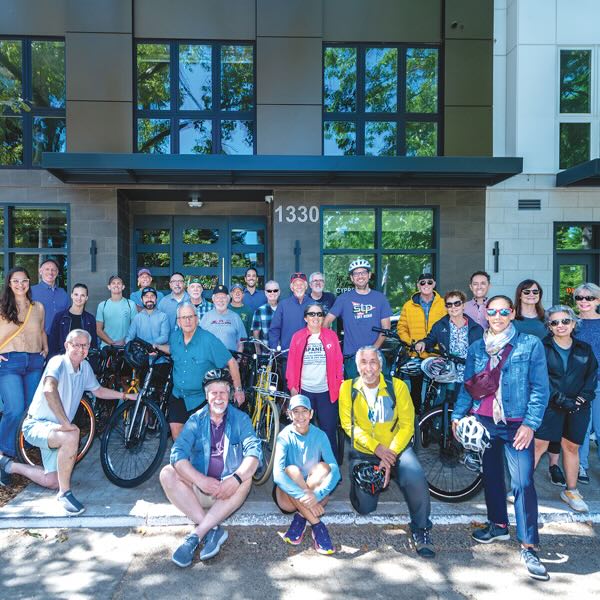
If you believe the old narrative that Sacramento is boring, oil your bike chain and join the next Cool Projects Bike Tour.
Organized by local planners and architects affiliated with Urban Land Institute Sacramento, the July ride was an eye-opening, uplifting experience. I tagged along with about 30 urban planning enthusiasts.
“It’s always a fun and informative ride,” says Tim Denham, a planner with the local firm Wood Rodgers. He and urban planners Bob Chase and John Hodgson, along with former mortgage broker Dean O’Brien, originated the rides in 2009.