

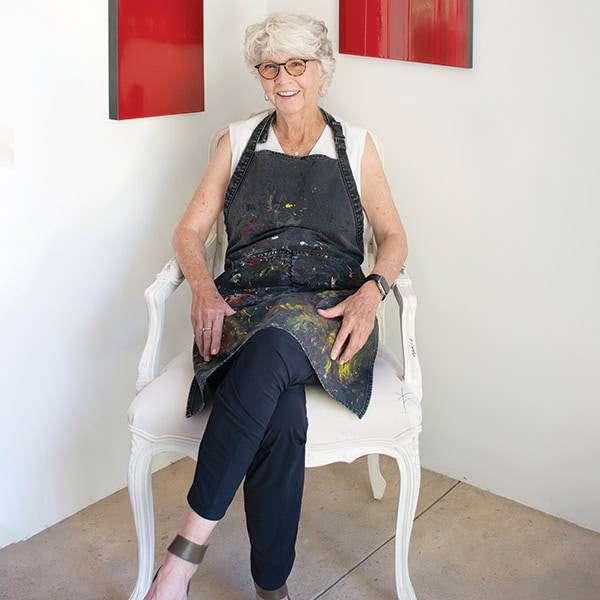
For Susan Poirier, the artistic journey toward minimalist abstraction is about uncovering what matters.
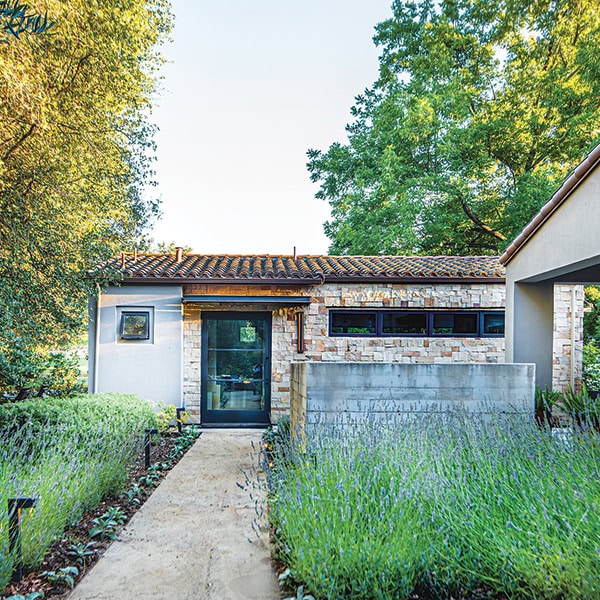
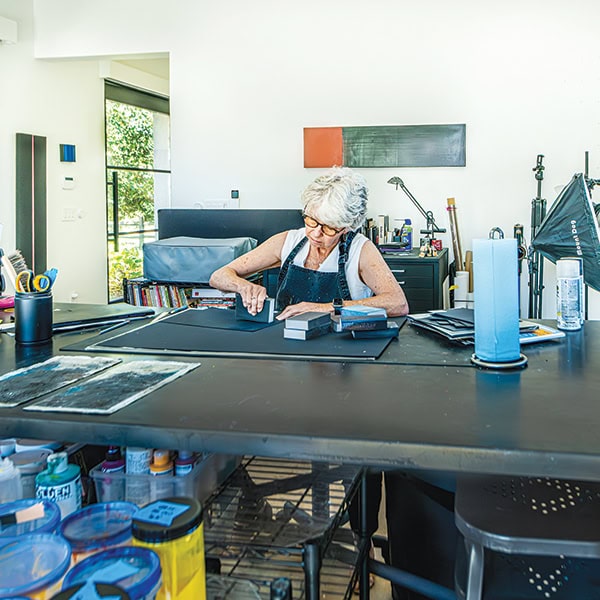
Born in Boston and shaped by a childhood of travel, Poirier spent much of her professional life as a critical-care nurse and educator. Now she maintains a disciplined routine, often spending days working in her home-based Carmichael studio surrounded by canvases in various stages of development.
Her work is defined by luminous surfaces, subtle textures and restrained fields of color created primarily with cold wax and oil. The paintings feel quiet yet emotionally charged. They are atmospheric works that invite viewers to slow down and linger.
Their simplicity appears effortless, but the path toward that refined visual language evolved gradually with years of experimentation, study and self-discovery.
Like many artists, she began traditionally. Early classes focused on drawing, watercolor and ceramics, with assignments in observation and technique. Those foundational years taught discipline and craftsmanship, but she realized technical skill was not enough.
“Technique is very different from creating from your heart,” she says.
Once she felt comfortable with the mechanics of making art, Poirier searched for something more personal and intuitive. The search led to encaustic painting, an ancient medium using beeswax, resin and pigment. The luminous quality of encaustic captivated her.
“There’s this incredible depth and glow to it,” she says. “You can build layers, scrape back into them, embed materials. The possibilities are endless.”
The discovery marked a turning point. While many artists use encaustic for representational imagery, she was drawn toward abstraction. The tactile nature of the medium encouraged experimentation rather than precision. Emotion and atmosphere took precedence over subject matter.
As her confidence grew, she began to enter local exhibitions and auctions. But another material shaped her artistic direction more profoundly: cold wax.
Unlike encaustic, cold wax doesn’t require heat or elaborate studio equipment. Mixed with oil paint, it creates velvety matte surfaces rich with texture and translucency. The medium offers greater flexibility, especially for an artist who travels often to visit family. More importantly, cold wax encourages restraint.
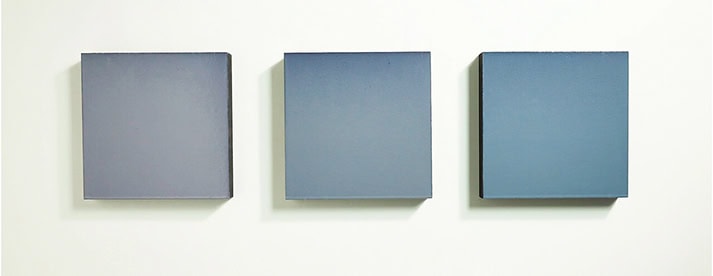
Over time, representational elements disappeared from her paintings. Shapes dissolved into layered fields of color. Marks became quieter and more intentional. What remained was atmosphere, texture and feeling.
“I kept paring things back,” she says. “Until only what mattered was left.”
That idea of reduction captures her artistic philosophy and the emotional resonance of her work. Rather than tell explicit stories, the paintings create space for reflection and interpretation. Their muted palettes and luminous surfaces suggest landscapes, memory, weather and light without defining any of them.

The evolution didn’t happen overnight. It emerged through years of painting, questioning and refining. Along the way, she sought guidance from Michael David, a mentor who encouraged her to move beyond technique and think deeply about the conceptual and emotional dimensions of art.
“I wanted to understand more about what art could mean,” she says. “Not just how to make it.”
That mentorship pushed her toward greater risks and experimentation. One memorable critique by David challenged her to literally disrupt a pair of paintings she had become attached to.
“He asked me to go outside and bury the painting in the earth,” she said. Reluctantly, she did. She discovered surrendering control opened new possibilities.
The experience reinforced an important lesson she continues to embrace: meaningful art emerges through uncertainty.
Her paintings reflect that philosophy. Built through repeated layering, scraping, sanding and revision, they carry traces of hidden histories beneath their surfaces.
Some works evolve quickly while others sit unfinished for months until the right balance reveals itself. The process requires her to listen closely to what each painting seems to need.
The resulting works have a meditative quality. Their minimalist compositions are not empty but deeply considered. Subtle shifts in tone, texture and luminosity become the subject.
Despite participating in regional exhibitions, she has largely avoided the traditional gallery system. She prefers to focus on her studio practice. At home in Carmichael, she maintains a disciplined routine, often spending entire days in the studio.
Some pieces are scraped back repeatedly until only fragments remain. Others are sanded smooth before new layers are added. The process can feel less like constructing an image than uncovering one.
Even after years of painting, her understanding of her art is still evolving. “I feel like I understand my work better now,” she says. “But I’m still discovering new insights all the time.”
Her artistic journey has been one of subtraction rather than addition. “I’ve removed distraction, noise and excess until only the essential remains,” she says.
Visit susanpoirierart.com.
Cecily Hastings can be reached at publisher@insidesacramento.com. Follow us on Facebook and Instagram: @insidesacramento.