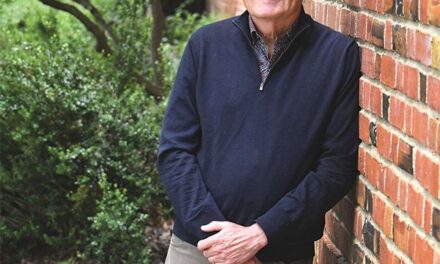


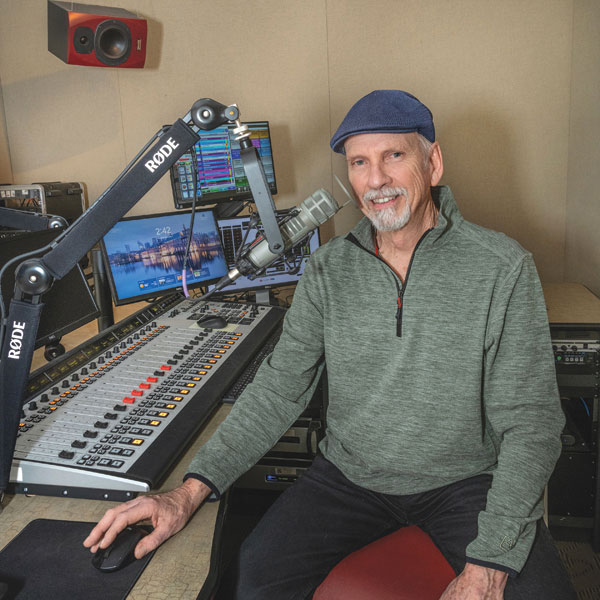
Beloved rock radio station K-ZAP is back on the airwaves, along with one its legendary voices, Dennis Newhall.
Newhall and a crew of about 20 rock aficionados launched the nonprofit K-ZAP in 2015 to recapture radio glory from the 1960s and ’70s. Then and now, the goal is, “Present the most interesting music in an honest and personable way. No hype. No jive. No bluster.”
And no corporate overlords. K-ZAP is run by volunteers, letting Newhall and crew keep it fun.
“Considering the pay grade, you can’t do anything that’s going to be hard,” Newhall says.
Radio has always been fun for Newhall. He grew up in West Sacramento asking his parents to drive him to Tower Records on Broadway.
When he reached Sac State, he “didn’t know what the hell I was doing” until a friend suggested he sign up for KERS, the school’s student station that became Capital Public Radio. The friend’s advice: “Pretend you’re on K-ZAP.”
Newhall taught himself broadcasting and soon had weekly air shifts.
In 1972, he got a real job at K-ZAP. After six weeks, he advanced to the afternoon drive, spinning whatever songs he liked.
That led to work as a production director in radio and advertising.
He helped run the Sacramento Rock & Radio Museum, with 5,000 items of local rock and roll memorabilia, many from Newhall’s collection.
The museum was housed in the Midtown headquarters of Nakamoto Productions. When the office closed in 2016, Newhall donated the collection to Sac State.
“I’ve become the de-facto go-to for rock and roll info for Sacramento,” Newhall says. “It’s mostly useless trivia.”
It’s also historical perspective. As the new K-ZAP general manager, program director and music director, Newhall “protects the format” by playing “some stuff you recognize, some new stuff,” all with no ads and real people on the air.
Thanks to technology, the talent doesn’t need a central studio.
“It’s a pre-recorded three-hour shift you can do from your house and it sounds like someone’s actually there, which makes it flexible,” Newhall says. “It turns out sounding so good, it sounds like we pass each other in the hallway.”
K-ZAP is streamed online through an app or on desktop. There’s also a low-power metro signal at 93.3 FM. The signal helped reunite the old crew.

“Two years before we came on the air, a lot of us got invited by (Davis radio station) KDVS for a weekend of K-ZAP, to do what we used to do at the station,” Newhall says. “People loved it.
“Then we got a notice about the FCC opening a window to grant low-power FM licenses and (K-ZAP colleague) Tom Kale and I started talking. We found out it wasn’t impossible, so we got a license put together. After a year, we got the OK. I started calling some old friends and they said, ‘Yeah, I’ll do that!’”
The new K-ZAP has listeners “scattered all over the place”—even the UK—with a dedicated local following. The station is supported by listeners who offer cash, vehicle and real estate donations and buy merch. K-ZAP’s grinning tomcat cartoon logo still draws fans.
When the station has extra funds, it gives back to nonprofits that provide media education for kids—G.I.R.L.S. Rock Sacramento, Blues in the Schools and Process Theatre.
“We play the good old stuff but also keep moving forward, which is fun and interesting,” Newhall says. “It’s all rock and roll, and damned if it doesn’t work.”
For information, visit k-zap.org.
Jessica Laskey can be reached at jessrlaskey@gmail.com. Follow us on Facebook, X and Instagram: @insidesacramento.