

Office Culture
Not just desks, Urban Hive links arts and community
By James Raia
October 2026
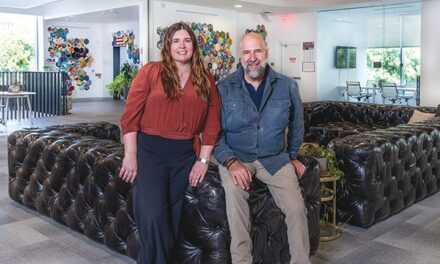
Brandon and Molly Weber were pioneers in the shared office space business when they started The Urban Hive 18 years ago. Now it’s an expanded industry, adapting to workplace trends.
At its fourth and largest location, the Downtown business is where individuals and companies meet, work and socialize. The Urban Hive long ago replaced cubicles with motifs of work by local artists. Drab hallways became open spaces with high-beam ceilings.
“I don’t see us as selling desks,” Brandon says. “A lot of co-working spaces, that’s their business. But I don’t want to talk about widgets. If we start talking about that for 30 minutes, then we become a widget manufacturer.”
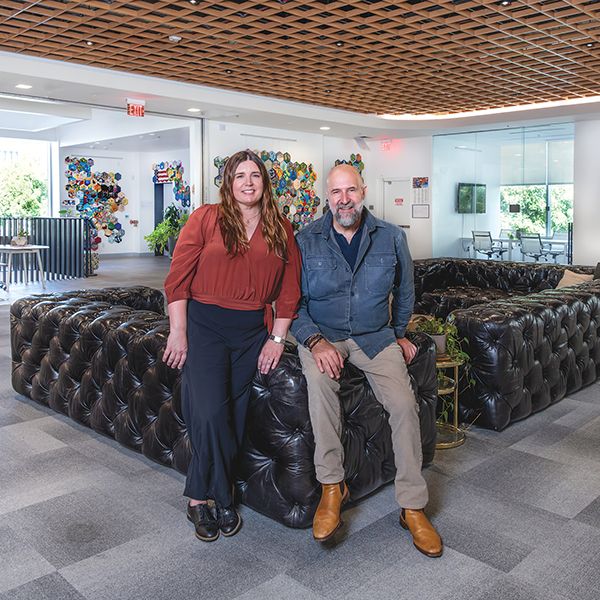
Photo by Aniko Kiezel
The company offers memberships in various categories, including Access, Creator, Founder, Desk and Office. There’s room for individuals and groups of more than 20.
The Urban Hive’s location at Seventh and I streets could be mistaken for a corporate office. Built in the early 1960s, the subtle exterior is a short elevator ride to an expansive gallery and work areas. Openness dominates. But there are closed glass doors, podcasting booths and even desks.
Freestanding and wall-mounted artwork, lounge chairs and couches provide the vibe.
“One of the most notable things is how much natural light we have in our space,” Molly says. “Even in our first location, light was very important to us.
“We are used to people coming to us from offices that are darker or their small home offices. We want to open that up and at the same time really get people working with each other.”
The community workspace industry suffered during the pandemic. It’s rebounded, the Webers explain, thanks to an increasingly varied clientele.
Startups, satellite offices for corporations, self-employed artists, writers and entrepreneurs are among The Urban Hive’s members.
“We’ve got more than 100 companies. Most of them are five people or less,” Brandon says. “We have a number of companies that are 15–20 people.”
One company has a core staff of nine in the office some days, but its 100 investors meet monthly or quarterly at The Urban Hive.
“That’s the way companies are these days,” Brandon says. “They’re not bringing in 100 people every day. It may be one or two, and even they may not be every day. Most people are working some sort of hybrid.”

The Urban Hive’s emphasis on art is seen in its current exhibit, The Honeycomb Project. On display until year’s end, the traveling piece features hundreds of small hexagonal artworks from different regions. The overall honeycomb structure is a metaphor for workplace and life-place community.
“Over the years, we’ve done shows with artists. We’ve helped curate, and other times I’ve done it all,” Molly says. “I’m kind of getting back into that place, but I also want to represent what Sacramento truly is.
“There are so many artists in Sacramento. It’s really giving them a place to shine and represent our space. But we like to mix it up.”
Brandon adds, “It’s a huge space. People can always find a quiet corner, have a cup of tea, sit along the windows and look at the trees.”
For information, visit theurbanhive.com.
James Raia can be reached at james@jamesraia.com. Follow us on Facebook and Instagram: @insidesacramento.