

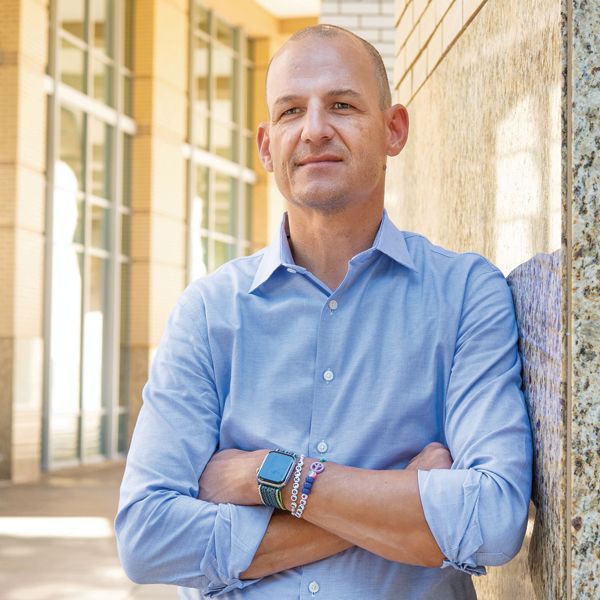
With his years on City Council and the state Assembly, Kevin McCarty brings more than two decades of elected public service to the mayor’s office.
He says being mayor requires a different perspective.
After 15 months in his new job, McCarty invited me to City Hall for what he called a “one-year check-in.” We discussed homelessness, Downtown’s recovery, government efficiency and what surprised him most about being mayor.
We began with homelessness. “There’s no question it’s the issue I deal with every day,” McCarty says.
The mayor believes California cities have been forced to expand their role in addressing homelessness, often without a roadmap. For decades, behavioral health and treatment services were primarily the responsibility of counties. But as encampments spread through urban neighborhoods, the pressure shifted to city governments.
“Cities have been building the airplane while flying it,” McCarty says.
Over the past year, the city tried to reassess what worked. Staff reviewed programs, compared outcomes and costs, data such as how many people move out of homelessness and how much programs cost per bed.
One conclusion: smaller shelter models are more effective.
Tiny home villages, McCarty says, offer a level of privacy and stability that large congregate shelters lack. Residents have privacy and space to store belongings, basic elements that create a sense of normalcy.
“Demand reflects that difference,” he says. The Roseville Road tiny home village has waiting lists while traditional shelters have open beds.
Sacramento added roughly 500 shelter beds since McCarty became mayor and is planning another expansion of similar size, with a mix of tiny homes, safe parking areas and other temporary housing options.
At the same time, enforcement of camping restrictions has increased following court decisions that clarified cities’ authority to regulate encampments.
McCarty believes residents are seeing improvements.
“When I ask people if things feel better, worse or the same, most say it’s a bit better,” he says. “Not fixed by any means, but maybe better.”

Another focus is evaluating how homelessness money is spent.
The city has reviewed contracts and programs to determine which ones produce results. Some show low success rates moving people into stable housing. The findings will drive changes.
“With limited money, we can’t afford programs that are average,” McCarty says. “We have to focus on the ones that work best.”
He credits city homelessness director Brian Pedro with bringing a more analytical approach to the problem, reviewing outcomes and cost effectiveness.
The shift helped Sacramento expand shelter capacity while facing declining state funding for homelessness programs.
But the city can’t solve homelessness alone. Mental health treatment and addiction services remain largely under county authority.
McCarty’s biggest surprise has been the slow pace of government projects. Funding secured years earlier can take years to translate into completed projects.
“Every few months something comes up on the agenda, and I realize it’s funding I secured in the Legislature three years ago,” he says.
To drive priorities forward, McCarty adopted a hands-on management approach, holding regular check-ins with city staff to keep projects moving.
One example is closing gaps in the river parkway trail system. The long-discussed goal is a continuous trail from Freeport to Folsom with no detours.
“It’s something people have been demanding for years,” McCarty says. “Now we’re meeting regularly to push it forward.”
When I raised the city’s efforts to bring employees back to the office, the mayor’s response was less convincing. He spoke about workforce members already required to report in person or work in the field, but not administrative staff who work remotely.
The atmosphere at City Hall feels subdued. While enforcement of return-to-office policies fall to the city manager, mayoral leadership and influence still matter.
Downtown presents another challenge.
Remote work reshapes the city center. Fewer office workers mean less activity for restaurants and shops. McCarty believes housing conversion will play a major role in Downtown’s future.
“More residents Downtown means more life on the streets,” he says.
One early step was the city’s decision to sell the Hale Building for housing. The property ended up in city ownership through a legal settlement. McCarty pushed to place the site back into private development.
“If we’re encouraging adaptive reuse Downtown, the city should lead by example,” he says.
Despite the challenges, one of the most rewarding aspects of being mayor is working on projects whose impact may not be realized for years.
River trail expansions, Downtown redevelopment and a future Major League Baseball expansion team fall into that category.
“These are things that might not happen overnight,” he says. “But they can shape Sacramento for decades.”
After 15 months, McCarty’s tone is pragmatic rather than triumphant. “The goal is steady movement in the right direction,” he says.
Cecily Hastings can be reached at publisher@insidepublications.com. Follow us on Facebook, X and Instagram: @insidesacramento.