

The trees can breathe easier, for now.
A U.S. district court temporarily stopped the U.S. Army Corps of Engineers from clearing hundreds of trees and miles of vegetation along the lower American River to make way for erosion-control work.
In granting the temporary injunction, the court found the plaintiffs would likely suffer “irreparable harm,” including the ability to use the affected portion of the river for recreation, such as hiking, dog walking and observing wildlife.

The Army Corps’ project, Contract 3B, would impact more than 3 miles of mature riparian forest from the Howe Avenue bridge to east of Watt Avenue on the north and south sides of the river.
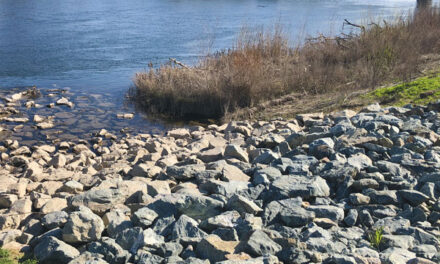
As many as 715 trees, including 300-year-old heritage oaks, would be removed and more than 1,100 trimmed to clear the area for erosion-protection measures that replace natural vegetation with riprap (boulder-sized rocks).
Community advocates oppose the work, calling for less-destructive alternatives, such as “engineering with nature,” which provide erosion protection while reducing habitat devastation.
When their efforts failed, three groups—American River Trees, Save the American River Association and Center for Biological Diversity—filed a lawsuit requesting consideration of bioengineering alternatives.
The lawsuit cites project inaccuracies, shortcomings and violations of federal and state Wild and Scenic Rivers Acts, National Environmental Policy Act and California Environmental Quality Act, among other laws.
The court’s injunction stops removal of trees and vegetation under Contract 3B until the lawsuit is resolved. “The court found that we raised significant questions in our claim that the Corps failed to fully evaluate less destructive alternatives,” Pete Spaulding with American River Trees says.
He adds, “The injunction is a victory for the American River Parkway, the public, the habitat. This bodes well for our likelihood of success at trial.”
For information on the lawsuit, visit americanrivertrees.com. For information on the Army Corps’ project, visit spk.usace.army.mil.
Cathryn Rakich can be reached at cathrynrakich@gmail.com. Follow us on Facebook and Instagram: @insidesacramento.