

My friend has a habit that makes me proud to know him and fear for his safety. On the sidewalks of Midtown and Downtown, he stands his ground when a bicycle barrels toward him.
His courage should inspire all pedestrians. He earns dirty looks and obscenities from sidewalk cyclists, but so far no broken bones or concussions. He’s never been hit.
My friend doesn’t yell at sidewalk cyclists. He says, “Hey, this is a sidewalk.”
I’ve concluded these idiots are too dumb to know. Stupidity is the best explanation, because I swear the number of people who ride bicycles on sidewalks in Midtown and Downtown grows whenever the city opens a new separated bike lane.
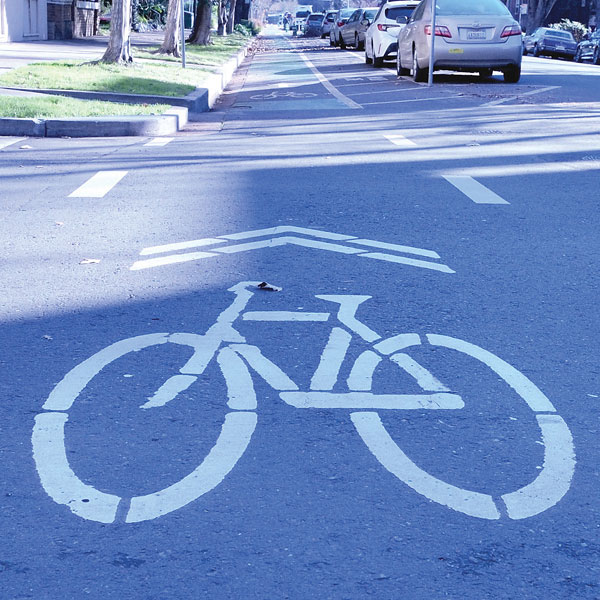
As green asphalt paint and plastic bollards go up, meatheads on two wheels take to the sidewalks. This happens all over town, not just when I’m leaving a bar or restaurant with my friend.
I’m not saying the city’s heroic effort to build bike lanes and create barriers between cyclists and vehicle traffic is a meaningless gesture.
As someone who rides a bike every week, I rank dedicated bike lanes far ahead of generative AI in terms of value to humanity.
But the city really should do something about those who ride bikes on sidewalks.
The problem is especially bad at night on P and Q and 19th and J streets, popular locations where the city spends millions realigning traffic flows to accommodate bicycles.
With vast splashes of reflective paint and bollards, the city is shifting street parking away from curbs to create safe, protected, easy-ride zones for cyclists.
Traffic engineers call the system “flexible delineators within the existing roadway prism,” justifying their college loans.
Separated bike lanes aren’t perfect. Motorists who try to cross an existing roadway prism flanked by flexible delineators have trouble seeing cyclists emerge behind parked cars.
But it’s better than the old days when a thin, blotchy white stripe was all that protected bicycles from cars and trucks zipping through town.
Creating separated bike lanes isn’t cheap. The city wants to have 12 miles of separated bike lanes, primarily on Midtown and Downtown streets. Each mile of flexible delineators costs about $3.5 million.

This means the city is spending $42 million to keep cars and cyclists apart. Yet numbskulls still ride on adjacent sidewalks, ignoring separated bike lanes.
I should mention that running down pedestrians on the sidewalk is a crime. But riding a bike on the sidewalk is legal unless there’s a sign that says otherwise.
Sacramento city code is insanely passive when it comes to bikes on sidewalks—ironic for a town that wants to spend $42 million on flexible delineators.
City code says officials must post no-riding signs on any sidewalk where cyclists are forbidden to ride. Absent a sign, boneheads ride with impunity.
But the code says even riders “must yield right-of-way to pedestrians by slowing down, stopping, or dismounting, as needed.”
If a cyclist gets caught not yielding, the fine is $25 for first offenders.
And if a dimwit can’t handle the $25 fine, the city has something called the “Sidewalk bike riding ticket diversion program.”
I asked the city’s transportation spokesperson for data on sidewalk bike citations and how the diversion program works. She didn’t provide any data, but said the program is an online class.
As for my friend, he knows it’s dangerous to stand your ground against cyclists. Such as the guy who now threatens to run us over on a Q Street sidewalk.
“I probably shouldn’t do this, but these guys belong in the bike lane,” my friend says.
He repeats his standard admonition, “Hey, this is a sidewalk.”
The jerk swerves around us. He shouts, “I got no brakes!”
I think about telling him he just admitted to violating a state law, California Vehicle Code Division 11, Chapter 1, Article 4, which says bicycles must have brakes.
But I let it go. Some cyclists are too dumb to know better.
R.E. Graswich can be reached at regraswich@icloud.com. Follow us on Facebook, X and Instagram: @insidesacramento.