

If you see a new well-designed, affordable apartment complex or hear a spirited conversation about how to get reasonably priced housing built, odds are John Vignocchi and his Urban Capital firm are involved.
Vignocchi, 39, has a solid reputation for creativity and commitment to building “workforce housing” people can actually afford.
“I made the decision to change my career in 2018 and decided I wanted to build housing,” Vignocchi says of shifting from solar energy to development. “But it didn’t really dawn on me until 2021 that I was driven to do something that was different, that I was passionate about and that was motivating.”
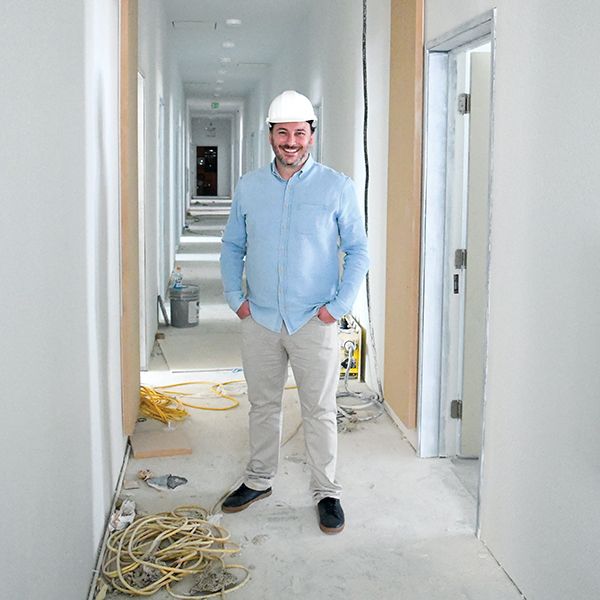
Photo by Linda Smolek
Raised by a single mom in Santa Barbara, Vignocchi decided to help resolve housing insecurity for working families—the kind of insecurity he experienced.
“There had to be a better of way of doing things where we could get more attainable housing built and drive down the costs,” he says. “Some of the smartest people in the business work on affordable housing, but we need better tools to make a real impact.”
One tool key to Urban Capital’s approach is the state’s “welfare tax exemption.” The state tax code lets developers who target low-income renters—people between 60% to 120% of the Area Median Income—avoid paying local property taxes.
Many developers use the exemption. Vignocchi found other ways to save money, primarily through greater density that reduces per-unit expenses without diminishing the product.
Recent examples include his 45-unit The Grace on 15th Street. Or Esperanza, which translates to “hope” in Spanish, under construction with 132 units on 12th Street.
Both have what the industry considers “top tier” amenities for rentals. Studios start at $1,400 a month. One-bedroom apartments go for $1,800, with two bedrooms at $2,200.
Vignocchi and Urban Capital are pursuing another ambitious project, 100 units of permanent housing in Rio Linda in partnership with the city and Gateway Development. Funding comes from the California Department of Housing and Community Development through its Homekey+ program.
The development has prefabricated 240-square-foot units each with kitchenette and bathroom. The site will include shared laundry, storage, community gathering spaces, a garden, on-site property management and supportive services.
It’s designed for people over 55, with about half the units reserved for homeless veterans with behavioral health issues.
“I’m kind of doing it to show the state we could solve the homeless problem with this model,” Vignocchi tells me. “It’s important to do it in Sacramento because the state is right in our backyard and we’re building them for $200,000 a door when all these other ‘affordable’ projects go for more than two or three times greater than that.”

Urban Capital sets its Rio Linda costs at $207,000 per unit, far below the $600,000 average for local income-restricted apartments. Vignocchi estimates the daily per-resident cost for housing and support at roughly $63.
If accurate, that number means the state’s 180,000 homeless people could be served for around $4 billion per year.
The details may be more complicated, but Vignocchi is convinced the Rio Linda project “demonstrates that with the right product, capital efficiency and operational model, we can move from managing homelessness to solving it, at scale, with dignity and at a cost the state can actually sustain.”
Construction in Rio Linda is scheduled to begin next year with occupancy in early 2028.
Gary Delsohn can be reached at gdelsohn@gmail.com. Follow us on Facebook and Instagram: @insidesacramento.