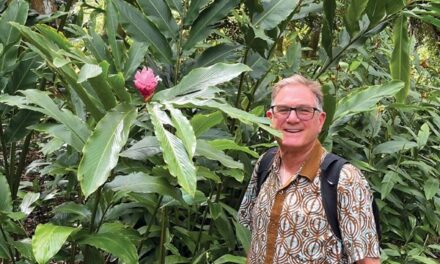


Not long ago, I read a Washington Post commentary on how to get more housing built. The author was Howard Husock, senior fellow at the American Enterprise Institute, a conservative think tank in Washington, D.C.
Husock has written several books on housing and is one of the country’s leading thinkers on the issue. I wondered how his ideas could apply to Sacramento. He was happy to talk.
My first question was, what’s right and wrong about California’s approach to solving its affordable housing crisis?

“First, you need to have an all-of-the-above approach to the problem,” Husock says. “Not only apartment buildings in transit-oriented developments. We need two-family housing. We need 40-unit apartment buildings.
“We need a variegated housing supply. I get concerned, and I think this is particularly true in California, that the YIMBYITes—the yes in my backyard pro-construction advocates—tend to favor transit-oriented development to the exclusion of other kinds of construction.”
Among smart steps taken by Sacramento and other California cities, Husock says, are allowing accessory dwelling units on the same lot as an existing home, and multi-family housing in neighborhoods historically zoned for single-family residences.
He understands why both moves spark neighborhood opposition.
“Homeowners have a vested interest in keeping their property values high and a lot of them feel that more multi-family housing and, god forbid, high-rises or anything that smacks of subsidized housing, is going to be a threat to their property values,” he says. “That’s why we see all over the country these single-family communities dig in their heels against anything that smacks of change.”
In his provocative 2021 book, “The Poor Side of Town: And Why We Need It,” Husock argues criticizing people who oppose such zoning changes is a bad idea.
“I said we can’t just beat up on these people. We have to understand where they’re coming from and try to persuade them that incremental changes are not a threat to them,” he says.
“I think the way to persuade them is to say, ‘OK, maybe on commercial streets, we are going to have multi-family housing. Or maybe in abandoned shopping malls, and California has a few of those. The parking lots can be converted to small apartment buildings.’
“They’ve got to be persuaded that new development is not a threat to their property values and their aesthetic sense of what makes a good neighborhood.”
Allowing accessory units appeals to Husock for another reason—one we don’t hear much about.
“California, like most high-cost areas, not only makes it difficult to build, but you make poor use of your existing housing,” he says. “You have a lot of aging baby boomers living in four-bedroom homes. If they could move to a new smaller unit on their own property and either sell or rent their existing domicile, that would be a better and higher use of that existing house.”

Not surprisingly, given where he works, Husock believes fewer regulations on builders and relaxing requirements of the California Environmental Quality Act—CEQA—should be part of the solution.
“CEQA has a way of inviting in litigants that include labor unions and others that increase construction costs and delays things,” he says.
We finished the conversation when I asked if we’re making progress, or are the problems too intractable to solve?
“All housing policy is local,” he says, “and it’s hard to say if you’re doing enough or not enough. But if you build more two-family houses, say, in the Inland Empire and more people are able to live there and you have good bus transit to Los Angeles (for jobs), that’s a good win.
“Or ADUs that allow younger families to move to the neighborhood they grew up in, that can be a big win. If we focus solely on aggregate statistics for the whole country and median home prices, yeah, it can get depressing.
“But if we open up new frontiers, including within the footprints of existing municipalities, we can make a lot of progress. Some of these programs really work but we have to be creative about them and not despair.”
Gary Delsohn can be reached at gdelsohn@gmail.com. Follow us on Facebook, X and Instagram: @insidesacramento.