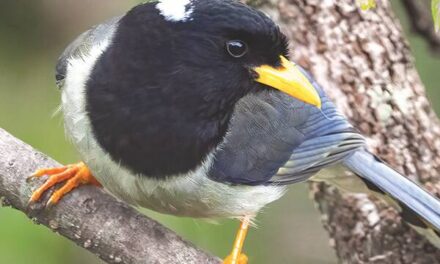


I used to take yellow-billed magpies for granted. In my younger years, flocks were everywhere in and around Sacramento.
Then West Nile Virus hit. By 2007, the gregarious black and white bird with the golden beak was decimated. Bird counts in the Central Valley declined by 80%.
Magpies, crows, ravens and jays—all in the corvid family—are susceptible to West Nile Virus. “They all crashed,” says Dan Airola, a local research wildlife biologist who has studied feathered species for decades.

While the other birds recovered, the magpie did not. “For some reason, it doesn’t appear the magpies developed a resistance to the disease,” Airola says.
The yellow-billed magpie is endemic to California, primarily inhabiting the Central Valley, Coast Ranges and Sierra Nevada foothills, from Redding to Santa Barbara. The yellow-billed version—compared to the black-billed magpie—has never been seen outside of California.
In 2020, Airola began monitoring the yellow-billed magpie in parks and other areas throughout Sacramento city and county. He reports encouraging numbers.
“My studies show the population is recovering at a measured and consistent pace—between 2% and 7% per year,” he says. Over seven years, “that’s a 35% increase.”
First, Airola had to count the birds. Since they colonize in one area and rarely move to other locations, he counted the nests—large domed structures made of sticks and mounted as high as 60 feet up in trees to avoid predators.
The nests are easily counted on leafless branches in the winter and early spring. Each nest represents two parents.
Inside the dome, the magpies create a mud nest that can weigh 2 to 3 pounds. “They have to carry these little balls of mud in their bills,” Airola says. He calculated about 600 trips to and from the river’s edge and nest. “It’s a big job.”
Because of the need for mud, the birds congregate close to a source, typically a riverbank. The closer to mud, the less effort to build the nests. When seen in neighborhoods, magpies are probably finding mud in irrigated areas. “The whole distribution of magpies in this region is the need for mud,” Airola says.
Foraging is another significant factor in magpie distribution. Low-growing herbaceous habitat, such as lawns or mowed grasslands, allow the omnivorous birds to easily pluck insects.
In the last two years, Airola has studied 22 sites, including Ancil Hoffman Park, William B. Pond Recreation Area, Oak Meadows Park and Howe Park, which has a creek that supplies the mud.
Discovery Park, where he counted 199 breeding pairs this year, “has by far the largest population,” he says.

Why the increase in Sacramento when other regions are still at an 80% decline? There are a couple hypotheses.
Earlier this year, the Sacramento-Yolo Mosquito and Vector Control District confirmed that a dead crow found in East Sacramento tested positive for West Nile Virus. While the disease is not eradicated, “for whatever reason, our population is now developing resistance,” Airola says.
West Nile Virus is transmitted through the bite of an infected mosquito. Magpies may receive protection through mosquito-abatement efforts meant to protect humans. “Just by happenstance magpies are benefiting from the work being done here,” Airola adds.
Yellow-billed magpies are boisterous, social and smart. They have adapted to urban life and survived a devasting disease. Spend some time watching, appreciating and getting to know this Central Valley native.
Cathryn Rakich can be reached at cathrynrakich@gmail.com. Follow us on Facebook and Instagram: @insidesacramento.